This entry is targeting general population of people. Specially written for my group of sedentary friends who needs an extra push to get their bums off the chair at their office and homes.
Why should we exercise?
Exercising increases metabolism rate.
Metabolism = the basic breakdown and restructuring of cells in our body (our body is made up of millions of cells, if you haven't know.).
When we fall sick or sometimes injure ourselves, cells are damaged or inflammed. Increased metabolism rate generally means that these damaged cells can be replaced at a faster rate. To some, it may mean faster time to recovery from sickness, to others it may mean getting more muscular or burning fat cells and building new muscular cells.
Basically exercising means doing something that raise our heart rate for a sustained period of time to increase the workload of our body.
So, when we go through our daily life, we use different fuel sources for energy. When we work out/exercise, the same occurs.
What sources are used are determined by the 3 energy systems that our body uses.
1) Anaerobic
2) Anaerobic Oxidative
3) Aerobic
Anaerobic system provides instant energy to explosive movements. Imagine 10m flat out sprints.
Anaerobic oxidative system provides energy to sustained high intensity workout of 2minutes and above (Highly possible to develop, depending on training).
Aerobic system is the system that provides energy to sustained low to moderate intensity. Imagine walking from your home to mrt stations, going through your daily lifestyle and also jogging at a conversational pace. This is what we will be touching on later.
-----------------------
Anaerobic system uses Simple sugar (the sweeter a food is, the more it is a simple sugar) and ATP.
Anaerobic system uses Simple sugar + Oxygen
Aerobic system uses mainly complex carbohydrates (Brown Rice, spag, wheat bread.. etc) and fats (when workout lasts more than 20/30mins (debatable topic here...))
For general population hoping to get a lifestyle with general fitness, Aerobic system is the system to train with, I.E low to moderate intensity workouts.
Which brings us to the following question...
Why should we choose lower intensity exercises over high intensity ones?
High intensity workout requires high muscular strength to withstand the impact created by the explosive movements.
e.g: Tuck jump. When you jump off the floor as high as possible and land back on the floor, the impact is created when the feet comes into contact with the ground. If there is not enough strength in the ligament & supporting muscles through base training, injury risk are at all time high.
Lower intensity workout causes less stress to the body's joints and muscular structures and thus its easier to recover from and done over and over again in a consistent basis.
Moreover, the lower intensity workout utilizes complex carbohydrates and fats... isn't that what all the people in this world (fat or thin) want to burn? Doing a lower intensity workout will allow you to do it over a prolong period of time (45 to 60 minutes or more!).
Thus in my opinions, it really beats doing 5 minutes of flat out sprint that burns all sugar and give you hell lots of aches and high risk of injury for those who merely wants a more healthy lifestyle.
The keyword here is consistent basis of low intensity workout - Done daily/alternate days. Each workout should be about 45 to 60 minutes, including 10 to 15minutes warmup and 10 minutes cooldown in that time frame. Without consistency, any kind of workout (high or low intensity regardless) will not show any physiological benefits (losing fats and gaining muscles are just one of those benefits).
So how do we know that we're training in the right system and intensity?
That introduce us to the next question.
Why should we exercise with Heart Rate monitors?
Heart rate monitors give us an arbitrary guideline that is very clear cut to follow.
General population that are sedentary can use this formula to get Max Heart Rate (MHR, the estimated maximum heart rate per minute that can be attained through a workout.).
MHR = 220 - Age
So for example, weihao is 26 yrs old.
220 - 26 will be 194.
A very simple way of making sure the intensity is at the right low/moderate level is to multiply that number by 75%.
Athletes may argue that their moderate effort are of higher HR, but this entry is for general populations.
So 0.75 of 194 is about 145 beats per minute.
Having a heart rate monitor as you jog, weihao'll be able to make sure that he is working out at UNDER 145 beats per minute (i.e 75% max heart rate).
This should be a conversational pace in the event that you can't afford a HR monitor, if you can't talk whilst you're jogging it means you're doing it at too high an intensity.
For obese personel, it is recommended that you use the Karvonen Formula to get a more accurate measurement of HR percentage.
Reason being that obese personnel have a higher resting heart rate usually and take this example for illustration...
Person A is 50 yrs old and obese and have a resting heart rate of 120.
His MHR is 220 - 50 = 170.
75% of his MHR is 127.5.
What that means is that when he is sitting down doing nothing, the heart rate is already 120... when he starts walking, he's going to be way above 127.5 already... Thus using Karvonen formula will be better as it takes into account of his resting heart rate. I shan't elaborate further to make this article lengthy, however, read the link below for more info.
Karvonen Formula Details
If you are very interested and still have enquiries, I'm just a sms away at 81800621 or can email me at enquiry@sapphireswimming.com
Cheers
KK
Sunday, July 18, 2010

Sunday, July 11, 2010
A special entry for a special brother of mine...
Welcome Alvin! :)
This is an incredible man who is the fastest runner in my school without ANY training, took up freestyle swim from me from SCRATCH in 5months or less? and did his first Sg Biathlon with me... The swim was a terrible one because of the course being a 1 big loop of 1.5km plus choppy water on the return... he suffered for 38 minutes or more in the water and came out of water to clock a 44minutes 10km run..
He did that without ANY RUN TRAINING. :)
Impressed was an understatement, I was DUMBFOUNDED. So, here we are looking at pictures and lines again! :)
---------------------
Below are pictures of his swim now.. and lets see how we can analyse and help him do better!
Before the bad things.... there is one good thing.. :P

His right side gliding side position is SOOO close to perfection. The white line is streamlining axis..
Now.......
--------------------------------------------


Looking at the red lines, we can see the body is not in streamlined position at certain times of the stroke, ideally it should be straight when your arm is extended.
--------------------------------------------

From the above, we can see the elbow is leading the pull and thus the anchoring catch position is not properly achieved. The anchoring position should have the elbow at where the green star is, then the forearm and wrist and palm directly below the elbow in one straightline, fingertips pointing to the floor and the palm facing the back.
and...

This one we can also see that the head is lifted high out to breathe. Thus the hip is sinking.. and the body isn't Streamlined...
-----------------------------------------

The entry of the arms are not at the near 11 and 1 o clock position but its aiming towards 12 o clock (your head/center axis) and thus causing the weight of the body to tip over whenever an entry is made.
---------------------------------------
Generally, I've shared that the recovery need to be faster, less cautious and thrown to the front instead of controlling the "piercing" motion at the finger tip.
The catch position have to be worked on. It is really about anchoring your palm and forearm onto one point in the water and then pulling your body through the liquid medium through a hip/body rotation.
Entry and leaning of chest into the water is led by body rotation and not the other way round (arm extension leading the body to stretch).
Keep the hips floating on the surface and especially when you breathe.
Keep doing slow swims to build the endurance up around the core first and remember to always do mindful swimming PRACTICE (not training...)!!!
The left arm is rather mechanical and thus you have to do more simulation of it on dryland until it feels like a One Movement kind of thing.
The kick should start from the hips and not from the knees and ankles.. remember the sequence:
Downbeat: Hip down --> knee down --> ankle stretched and then down...
Upbeat: buttock up, pulling the leg Straight up til ankle slightly break the surface.
That will be all for now!
Cheers
KK
Of course, the stills don't do justice.. so here are The Videos!
This is an incredible man who is the fastest runner in my school without ANY training, took up freestyle swim from me from SCRATCH in 5months or less? and did his first Sg Biathlon with me... The swim was a terrible one because of the course being a 1 big loop of 1.5km plus choppy water on the return... he suffered for 38 minutes or more in the water and came out of water to clock a 44minutes 10km run..
He did that without ANY RUN TRAINING. :)
Impressed was an understatement, I was DUMBFOUNDED. So, here we are looking at pictures and lines again! :)
---------------------
Below are pictures of his swim now.. and lets see how we can analyse and help him do better!
Before the bad things.... there is one good thing.. :P
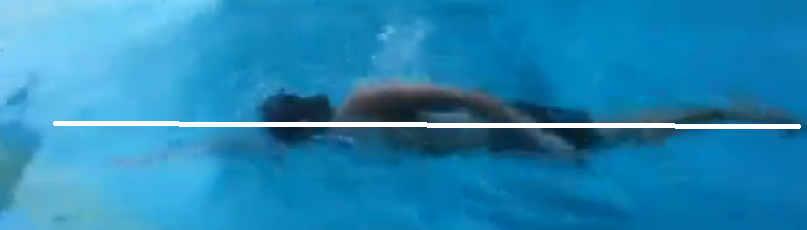
His right side gliding side position is SOOO close to perfection. The white line is streamlining axis..
Now.......
--------------------------------------------


Looking at the red lines, we can see the body is not in streamlined position at certain times of the stroke, ideally it should be straight when your arm is extended.
--------------------------------------------

From the above, we can see the elbow is leading the pull and thus the anchoring catch position is not properly achieved. The anchoring position should have the elbow at where the green star is, then the forearm and wrist and palm directly below the elbow in one straightline, fingertips pointing to the floor and the palm facing the back.
and...

This one we can also see that the head is lifted high out to breathe. Thus the hip is sinking.. and the body isn't Streamlined...
-----------------------------------------
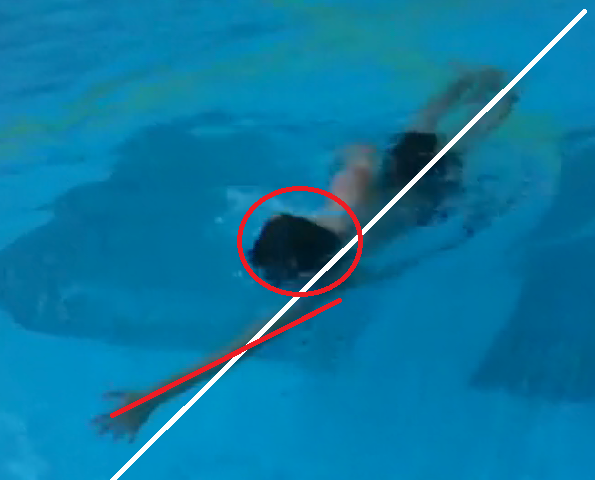
The entry of the arms are not at the near 11 and 1 o clock position but its aiming towards 12 o clock (your head/center axis) and thus causing the weight of the body to tip over whenever an entry is made.
---------------------------------------
Generally, I've shared that the recovery need to be faster, less cautious and thrown to the front instead of controlling the "piercing" motion at the finger tip.
The catch position have to be worked on. It is really about anchoring your palm and forearm onto one point in the water and then pulling your body through the liquid medium through a hip/body rotation.
Entry and leaning of chest into the water is led by body rotation and not the other way round (arm extension leading the body to stretch).
Keep the hips floating on the surface and especially when you breathe.
Keep doing slow swims to build the endurance up around the core first and remember to always do mindful swimming PRACTICE (not training...)!!!
The left arm is rather mechanical and thus you have to do more simulation of it on dryland until it feels like a One Movement kind of thing.
The kick should start from the hips and not from the knees and ankles.. remember the sequence:
Downbeat: Hip down --> knee down --> ankle stretched and then down...
Upbeat: buttock up, pulling the leg Straight up til ankle slightly break the surface.
That will be all for now!
Cheers
KK
Of course, the stills don't do justice.. so here are The Videos!
:D
Saturday, July 10, 2010
Stroke Analysis.
AHhhh.. here comes the BORINGEST and Most Impt update everybody *is* looking forward to! LOL...
Arvind
Firstly, the stroke is almost perfect. The only restraint that is causing you to have a slower swim than what you ought to be doing is your control over your legs' movements.
Note that I did not use the phrase "lack of power in your kick" because you Have power in your kick, else you won't be able to balance your rotating body to your side with such a strong hip thrust everytime you do a strong pull.
Your strength in your pull doesn't come from your arm as we can all see that your arm isn't all that strong looking or having much muscular hypertrophy. However what we can see is GREAT trapezius and latissimus dorsi development and shoulder stability (in your catch). Other than strength, you also a flexible shoulder girdle that allowed a long pull starting with a REALLY EARLY catch out at the front before your forehead.
Your legs muscles lack good control without conscious thinking. For now, you have to consciously kick then you can do a continuous kick. But as all endurance athletes know, if you have to keep thinking and focusing on doing a specific part(the kick) of a movement(the swim) then you have not mastered it yet and thus is at the Cognitive stage. I.e you'll be wasting more energy to perform it than those who had master how to move the legs in the 3beats/pull manner and can do it without thinking.
From now on, I suggest you do all warmup swims with Easy Pull + 3 beat kicks. :)
Vincent
Seriously I've been waiting for this opportunity to show itself and let it in turn show you what I mean by stroking is more impt than fitness. No doubt you're probably the fittest anaerobic guy in our team, second to none according to your age group.
However, the bad habit of just whacking thru the thousands of laps of swims since so long ago before you join the training has surfaced itself to haunt you again when we did a sprint Time Trial.
Judging from your words tht you want to do a decent timing or have a good finish/go at a triathlon, I can bet that you'd be going at this effort at the start when everyone is in a chaotic washing machine start of the open water swim. At by the end of 400m (without rest somemore..) your timing will be shredded to 2mins+ per 100m (or even slower..) and your RPE (Rate of Perceived Exertion) will be at 25 on a scale of 20. You can imagine how badly your race will become despite all the fitness training you've put yourself into already.
My advice is that from now on, you do every single swim, fast or slow with a conscious mind. Never should there be a swim that you will be doing without thinking or doing at a rate where you Can't think.
The fastest swim time is achieved when two components is achieved.
Holding your best form + Highest exertion possible before breakdown of form.
Take note that it is Highest Possible Exertion, BEFORE breaking down of your stroke technique. Once you exert higher than you can control, you'd be DEEPLY into anaerobic and you can't think, your stroke technique falters and all energy will go into waste instead of making you travel forward.
Start slow, swim fast set only at a CONTROLLED hard pace. That way you train yourself to swim the fastest you can, and not swim with the strongest pull that you can do neglecting all other aspect of the stroke. It is Kung Fu, not brute force. :)
If you take a look at your timing, the 2nd set was worst, and then the third and fourth set each improved by 2 seconds. That is because your arms had fatigued, and you're no longer applying as much force and at the same crazy high stroke rate.. thus your stroke slowed down, and allowing a Longer distance travelled per stroke. Thus the improve in timing through the third and fourth set, despite the fatigue!
KH
Your swim has always been bothered by the pull timing. I've explained to you on the way home, that you have to recover the arm a little faster and thus you can start the pull a little earlier, leaving lesser time to glide and thus losing lesser velocity!
If you take so long to recover your arm then your extended arm in front will be forced to wait and glide until you lose velocity. Right now your pull isn't strong at all, and there isn't much velocity to lose.. means it always come down to Zero propulsion whenever you finished gliding and before you start the next pull!
Moreover, your breathing is a little high headed and hips sink quite a bit. It is thus important to stretch in front and open up your arm pit by making sure the left palm (extended arm) is facing flat towards the floor as you rotate to the right to breathe.
I think another key is Rotating lesser than what you're doing now to the side will help alot in gaining stability in your left to right to left arm pull transitions. Also the added stability will help in keeping your breathing easier, without the constant feeling of tipping over to the back and having to rush your breathe before you lose balance while on the side.
Specifically, Left arm recovery is Extremely slow, both palms met each other before Right arm pull starts, thus lost velocity.
Left arm pull is too early when you're breathing, have to wait for your right arm to come back to the front and before it enters then start pulling. Remember to recover slightly faster so the left arm isn't waiting too long either.
Suggestion to you is to make your way down to the batok pool to swim whenever you have time!!! Don't wait til race day coming then you train, this is NOT like running short 2.4 distance..... Takes time to build up the endurance and engrave the correct techniques leh.. don't play play hor brother... You're very impt to me okay.
Andy
From the swim, we can all see that you need to spend a little more time thinking about the pacing in swimming versus running. If we take a look at the 84km run splits, we'll see also that the 1st and second 10km was a little on the fast side for a 84km run and then the subsequent splits of 10km was a little on the slow side already given your standard and the amount of base training you've done before the race; albeit i've never done it before but it really does seem like a pacing issue to me. Ernest also noted a preference to chiong very hard at the start during rides! Remember to Reserve and Conserve for maximal performance!!! :)
Your entry is still slicing in from pinky finger inwards. Should be index finger and thumb first, once entered wrist deep, then stretch forward.
I'd suggest to kick lesser and try to swim with more core rotation, its like why let the legs do the job when you can rest them for the bike and run? :)
Ernest
Firstly, my apologies to you for keeping you waiting when you were so shagged from the swim and asking me if there is a debrief. I was busy explaining to Marianne how to do the leg kick before the lifeguard use the torpedo buoy to pull us out of the pool and close the shop! Thank you for your patience. :)
You've done very well thus far in the aspect of controlling the exertion of your leg kicks. It is really impressive to me that you can get the movements to be really smooth and continuous. It shows that you've been putting a lot of heart into developing the finesse and not just using the fitness you already have. I guess it must have been a motivation that came from a terrible first open water swim last yr that you shared. It's doing you good now that you didn't drown there and then.. :P
The only issue I see in your swim now that you need to IMMEDIATELY resolve, is the stretching of your torso and your arms. Take note the stretch starts from your hips up your spine and abs, to your armpit of and your leading arm.
Your pull is really short, especially on your left arm, it ends mid torso when it should end somewhere pass the hips.
Get those 2 issues sorted out first, have discipline in doing them slowly and you'll grasp them faster than you expect. :)
Marianne
Da Jie, you really ought to swim more and watch lesser dramas la.. :D Don't let the good strokes go to a waste! Your strokes are almost perfect now except for the need to work on your kick... look at Arvind's issue.. I lazy to retype!
I can now see that your fast swim is really taxing on your cardio respiratory systems... You were panting and breatheless like everyone else but your timing didn't reflect the same. It shows a weak Cardiorespiratory system despite a good stroke oh... And if I may say something here.. don't.. s**** that much la.. its taking a toll on your lungs much earlier than you expect it to be... can be life endangering... I know you know, but knowing is different from understanding, and understanding is different from accepting, and accepting is different from putting an action on it..
Jia you ok ? :)
Samantha
First up, your lead arms(yes both) are always floating upwards after entering deep! Causing ALOT OF DRAG LA!Its like SO wasted you know? You got really good upper torso strength, dun ask how I know... but yes, its not being utilized to its fullest potential because of the drag you're creating at the most critical frontal area (your extended arm)! JUST LIKE *SI LING*!!!
Your right beat kick tend to kick a lot from the knee still albeit there's improvement from last time... and your left beat kick is incredibly lazy oh... ;)
Your breathing is late... should be in this sequence:
(i) Rotate body and go to catch,
(ii) Rotate abit more to cork the core at the catch to prepare for propulsion phase,
(iii)At the same time as (ii), rotating your head to exit water
(iv)Face exits water to inhale as rotation of the body occurs at the same time,
(v)Pulling arm is now at chest level and Inhalation is COMPLETE.
(vi)Push phase of the arm continues as you turn your face back into the water
(vii)Transit to the next pull with rotation (back to i).
You're doing part (iv) at end of part (vii)! Hope you understand! JIAYOU JIAYOU JIAYOU!!! so happy everyone says you're slim now! haha..
For your swim, I suggest doing bilateral breathing swims during the warmups and looking at your arms to make sure they stay in place. Then during main set swims when you have to look down, keep a mental note of it and occasionally look at the arm in front to make sure they're in place too.
The kick wise you have to practice with the kick with board and have discipline to let the kick start from your core and buttock must move! :)
Lawrence
Incredible first set for your still-flawed pulling technique! However,fatigue sets in and stroke deteoriates even more as you try to maintain a same stroke rate/exertion.
Basically its the same old problem. Arms are pulling past the center axis of your body, especially when you're breathing. Try to keep in mind that the extended arm is actually pointing slightly outward (if your head is 12o clock, the left arm is pointing at 11o clock, and if right arm is extended, its pointing at 1).
When you pull, try to keep it outside, because your concept of pulling the arm close to the body's middle is causing the body to it a little extreme. Especially when the pull passed your scope of vision, I.e the push phase when its passed your chest... it went way too far across the other side before sweeping it back out.. drawing a huge 'S' in the water... That caused a lot of unwanted lateral movements in your swim when you're supposed to be moving forward.
Last but not least, we look forward to your return and be safe in ShangHai! Gout go away!!!!
TeckBeng
The kick is now activated and you can see a tremendous improvement in your swim timing. Great pacing, great stroke maintenance and great breathing control under pressure. :)
Only issue is your kick isn't starting from your hip and core. You got long limbs and if you do your kick like what you're doing now, starting from the knees, the hip will be flexing and thus dropping under the surface to cause your leg to sink even more.
Left arm's catch can be a little further out, you breathe on your right and thus the left arm catch isn't noticable. Put more focus on it! :)
Calvin
Who say you got no power??? Who say you got no stamina??? Who say that relax relax swimming cannot improve timing?? who? who? who???? :P
Crazy first set timing I'm sure you yourself was stunned.
Take note to keep the arms a little deeper but more importantly, you need to lean more into the water via your chest and thus your buttock and break the surface a little. That will keep the hip up and thus with your fantastic kick (straight and long and easy kicks) your body will be hugging the surface as you pull yourself through the water.
Other than that, I think you deserve the Most Improved SlackerMan Award. :P
Si Ling
WELCOME WELCOME!!! Even though I don't know if you got internet to read this.... :P
I think your swim technique is really good. China train you guys well, I'm serious, no sarcasm here. Look at our own sg lifeguards and I felt like strangling them, no, the examiners actually, for PASSING them on their lifeguarding course. Cannot even swim properly and so fat and still wanna save people? Act as flotation device is it?
Ok ok.. grudges aside..
The extended arm is always snaking upwards and end up your palm is facing the front! It is literally putting a stop to your forward moving momentum. Once your entry slides into the water, you have to keep it down and straightened. Don't let it float up again! Just like *SAMANTHA*.
Second issue I saw in the first impression of your swim is your left arm is always sweeping across the center axis very badly especially when you breathe.
I suggest you do more 3 pull one breathe to alternate breathing sides so you can better manage your pulling technique!
Wilson
You got very strong power versus your dropped body weight now and that explains the speed that comes. However, I see a very major flaw in your pull as you delibrately flex your wrist a lot to make the palm face backwards first before dropping the forearm to face backwards.
The palm and the forearm MUST be in one piece. When I swam pass you and saw you breaking them into two, I knew you couldn't catch up despite I was slowing down in front waiting for you to pass because you just couldn't hold the water to pull yourself through.
Overall, as per noted by lawrence and many others your swim has improved at an alarming rate since november struggles and december drowning til now you're pretty fish like except its a robotic fish. :P
Kindly work on your catch for both arms and smoothing out the edges of those robotic movements transiting from one pull to the other. Try looking at the *LADIES* swim, they have Excellent transit of one stroke to another esp. Gen and Sam.
Genevieve
Sad to hear that you'd be leaving our training for badminton liao but to each of his/her own la.
Anyway, as per mentioned to you during your short swim this afternoon, your high elbow at your pull phase tend to drop at the push phase, i.e once your arm passed your scope of vision when its passed by the chest. Causing lesser surface area to be facing backwards as you pull your Arm through the water instead of pulling your Body through the water.
After the correction your stroke looks much better and you too felt stronger! Your left arm need to correct abit more still though, its short pulling, remember to end passing the hips.
I can guarantee you swim better 100s and 200s than ANY RIO VISTA MEN IN THE EARLY MORNING SWIM NOW (me excluded. I do afternoon and night swims. :P).
-------------------------------
That's all for now folks.
Cheers
KK
Arvind
Firstly, the stroke is almost perfect. The only restraint that is causing you to have a slower swim than what you ought to be doing is your control over your legs' movements.
Note that I did not use the phrase "lack of power in your kick" because you Have power in your kick, else you won't be able to balance your rotating body to your side with such a strong hip thrust everytime you do a strong pull.
Your strength in your pull doesn't come from your arm as we can all see that your arm isn't all that strong looking or having much muscular hypertrophy. However what we can see is GREAT trapezius and latissimus dorsi development and shoulder stability (in your catch). Other than strength, you also a flexible shoulder girdle that allowed a long pull starting with a REALLY EARLY catch out at the front before your forehead.
Your legs muscles lack good control without conscious thinking. For now, you have to consciously kick then you can do a continuous kick. But as all endurance athletes know, if you have to keep thinking and focusing on doing a specific part(the kick) of a movement(the swim) then you have not mastered it yet and thus is at the Cognitive stage. I.e you'll be wasting more energy to perform it than those who had master how to move the legs in the 3beats/pull manner and can do it without thinking.
From now on, I suggest you do all warmup swims with Easy Pull + 3 beat kicks. :)
Vincent
Seriously I've been waiting for this opportunity to show itself and let it in turn show you what I mean by stroking is more impt than fitness. No doubt you're probably the fittest anaerobic guy in our team, second to none according to your age group.
However, the bad habit of just whacking thru the thousands of laps of swims since so long ago before you join the training has surfaced itself to haunt you again when we did a sprint Time Trial.
Judging from your words tht you want to do a decent timing or have a good finish/go at a triathlon, I can bet that you'd be going at this effort at the start when everyone is in a chaotic washing machine start of the open water swim. At by the end of 400m (without rest somemore..) your timing will be shredded to 2mins+ per 100m (or even slower..) and your RPE (Rate of Perceived Exertion) will be at 25 on a scale of 20. You can imagine how badly your race will become despite all the fitness training you've put yourself into already.
My advice is that from now on, you do every single swim, fast or slow with a conscious mind. Never should there be a swim that you will be doing without thinking or doing at a rate where you Can't think.
The fastest swim time is achieved when two components is achieved.
Holding your best form + Highest exertion possible before breakdown of form.
Take note that it is Highest Possible Exertion, BEFORE breaking down of your stroke technique. Once you exert higher than you can control, you'd be DEEPLY into anaerobic and you can't think, your stroke technique falters and all energy will go into waste instead of making you travel forward.
Start slow, swim fast set only at a CONTROLLED hard pace. That way you train yourself to swim the fastest you can, and not swim with the strongest pull that you can do neglecting all other aspect of the stroke. It is Kung Fu, not brute force. :)
If you take a look at your timing, the 2nd set was worst, and then the third and fourth set each improved by 2 seconds. That is because your arms had fatigued, and you're no longer applying as much force and at the same crazy high stroke rate.. thus your stroke slowed down, and allowing a Longer distance travelled per stroke. Thus the improve in timing through the third and fourth set, despite the fatigue!
KH
Your swim has always been bothered by the pull timing. I've explained to you on the way home, that you have to recover the arm a little faster and thus you can start the pull a little earlier, leaving lesser time to glide and thus losing lesser velocity!
If you take so long to recover your arm then your extended arm in front will be forced to wait and glide until you lose velocity. Right now your pull isn't strong at all, and there isn't much velocity to lose.. means it always come down to Zero propulsion whenever you finished gliding and before you start the next pull!
Moreover, your breathing is a little high headed and hips sink quite a bit. It is thus important to stretch in front and open up your arm pit by making sure the left palm (extended arm) is facing flat towards the floor as you rotate to the right to breathe.
I think another key is Rotating lesser than what you're doing now to the side will help alot in gaining stability in your left to right to left arm pull transitions. Also the added stability will help in keeping your breathing easier, without the constant feeling of tipping over to the back and having to rush your breathe before you lose balance while on the side.
Specifically, Left arm recovery is Extremely slow, both palms met each other before Right arm pull starts, thus lost velocity.
Left arm pull is too early when you're breathing, have to wait for your right arm to come back to the front and before it enters then start pulling. Remember to recover slightly faster so the left arm isn't waiting too long either.
Suggestion to you is to make your way down to the batok pool to swim whenever you have time!!! Don't wait til race day coming then you train, this is NOT like running short 2.4 distance..... Takes time to build up the endurance and engrave the correct techniques leh.. don't play play hor brother... You're very impt to me okay.
Andy
From the swim, we can all see that you need to spend a little more time thinking about the pacing in swimming versus running. If we take a look at the 84km run splits, we'll see also that the 1st and second 10km was a little on the fast side for a 84km run and then the subsequent splits of 10km was a little on the slow side already given your standard and the amount of base training you've done before the race; albeit i've never done it before but it really does seem like a pacing issue to me. Ernest also noted a preference to chiong very hard at the start during rides! Remember to Reserve and Conserve for maximal performance!!! :)
Your entry is still slicing in from pinky finger inwards. Should be index finger and thumb first, once entered wrist deep, then stretch forward.
I'd suggest to kick lesser and try to swim with more core rotation, its like why let the legs do the job when you can rest them for the bike and run? :)
Ernest
Firstly, my apologies to you for keeping you waiting when you were so shagged from the swim and asking me if there is a debrief. I was busy explaining to Marianne how to do the leg kick before the lifeguard use the torpedo buoy to pull us out of the pool and close the shop! Thank you for your patience. :)
You've done very well thus far in the aspect of controlling the exertion of your leg kicks. It is really impressive to me that you can get the movements to be really smooth and continuous. It shows that you've been putting a lot of heart into developing the finesse and not just using the fitness you already have. I guess it must have been a motivation that came from a terrible first open water swim last yr that you shared. It's doing you good now that you didn't drown there and then.. :P
The only issue I see in your swim now that you need to IMMEDIATELY resolve, is the stretching of your torso and your arms. Take note the stretch starts from your hips up your spine and abs, to your armpit of and your leading arm.
Your pull is really short, especially on your left arm, it ends mid torso when it should end somewhere pass the hips.
Get those 2 issues sorted out first, have discipline in doing them slowly and you'll grasp them faster than you expect. :)
Marianne
Da Jie, you really ought to swim more and watch lesser dramas la.. :D Don't let the good strokes go to a waste! Your strokes are almost perfect now except for the need to work on your kick... look at Arvind's issue.. I lazy to retype!
I can now see that your fast swim is really taxing on your cardio respiratory systems... You were panting and breatheless like everyone else but your timing didn't reflect the same. It shows a weak Cardiorespiratory system despite a good stroke oh... And if I may say something here.. don't.. s**** that much la.. its taking a toll on your lungs much earlier than you expect it to be... can be life endangering... I know you know, but knowing is different from understanding, and understanding is different from accepting, and accepting is different from putting an action on it..
Jia you ok ? :)
Samantha
First up, your lead arms(yes both) are always floating upwards after entering deep! Causing ALOT OF DRAG LA!Its like SO wasted you know? You got really good upper torso strength, dun ask how I know... but yes, its not being utilized to its fullest potential because of the drag you're creating at the most critical frontal area (your extended arm)! JUST LIKE *SI LING*!!!
Your right beat kick tend to kick a lot from the knee still albeit there's improvement from last time... and your left beat kick is incredibly lazy oh... ;)
Your breathing is late... should be in this sequence:
(i) Rotate body and go to catch,
(ii) Rotate abit more to cork the core at the catch to prepare for propulsion phase,
(iii)At the same time as (ii), rotating your head to exit water
(iv)Face exits water to inhale as rotation of the body occurs at the same time,
(v)Pulling arm is now at chest level and Inhalation is COMPLETE.
(vi)Push phase of the arm continues as you turn your face back into the water
(vii)Transit to the next pull with rotation (back to i).
You're doing part (iv) at end of part (vii)! Hope you understand! JIAYOU JIAYOU JIAYOU!!! so happy everyone says you're slim now! haha..
For your swim, I suggest doing bilateral breathing swims during the warmups and looking at your arms to make sure they stay in place. Then during main set swims when you have to look down, keep a mental note of it and occasionally look at the arm in front to make sure they're in place too.
The kick wise you have to practice with the kick with board and have discipline to let the kick start from your core and buttock must move! :)
Lawrence
Incredible first set for your still-flawed pulling technique! However,fatigue sets in and stroke deteoriates even more as you try to maintain a same stroke rate/exertion.
Basically its the same old problem. Arms are pulling past the center axis of your body, especially when you're breathing. Try to keep in mind that the extended arm is actually pointing slightly outward (if your head is 12o clock, the left arm is pointing at 11o clock, and if right arm is extended, its pointing at 1).
When you pull, try to keep it outside, because your concept of pulling the arm close to the body's middle is causing the body to it a little extreme. Especially when the pull passed your scope of vision, I.e the push phase when its passed your chest... it went way too far across the other side before sweeping it back out.. drawing a huge 'S' in the water... That caused a lot of unwanted lateral movements in your swim when you're supposed to be moving forward.
Last but not least, we look forward to your return and be safe in ShangHai! Gout go away!!!!
TeckBeng
The kick is now activated and you can see a tremendous improvement in your swim timing. Great pacing, great stroke maintenance and great breathing control under pressure. :)
Only issue is your kick isn't starting from your hip and core. You got long limbs and if you do your kick like what you're doing now, starting from the knees, the hip will be flexing and thus dropping under the surface to cause your leg to sink even more.
Left arm's catch can be a little further out, you breathe on your right and thus the left arm catch isn't noticable. Put more focus on it! :)
Calvin
Who say you got no power??? Who say you got no stamina??? Who say that relax relax swimming cannot improve timing?? who? who? who???? :P
Crazy first set timing I'm sure you yourself was stunned.
Take note to keep the arms a little deeper but more importantly, you need to lean more into the water via your chest and thus your buttock and break the surface a little. That will keep the hip up and thus with your fantastic kick (straight and long and easy kicks) your body will be hugging the surface as you pull yourself through the water.
Other than that, I think you deserve the Most Improved SlackerMan Award. :P
Si Ling
WELCOME WELCOME!!! Even though I don't know if you got internet to read this.... :P
I think your swim technique is really good. China train you guys well, I'm serious, no sarcasm here. Look at our own sg lifeguards and I felt like strangling them, no, the examiners actually, for PASSING them on their lifeguarding course. Cannot even swim properly and so fat and still wanna save people? Act as flotation device is it?
Ok ok.. grudges aside..
The extended arm is always snaking upwards and end up your palm is facing the front! It is literally putting a stop to your forward moving momentum. Once your entry slides into the water, you have to keep it down and straightened. Don't let it float up again! Just like *SAMANTHA*.
Second issue I saw in the first impression of your swim is your left arm is always sweeping across the center axis very badly especially when you breathe.
I suggest you do more 3 pull one breathe to alternate breathing sides so you can better manage your pulling technique!
Wilson
You got very strong power versus your dropped body weight now and that explains the speed that comes. However, I see a very major flaw in your pull as you delibrately flex your wrist a lot to make the palm face backwards first before dropping the forearm to face backwards.
The palm and the forearm MUST be in one piece. When I swam pass you and saw you breaking them into two, I knew you couldn't catch up despite I was slowing down in front waiting for you to pass because you just couldn't hold the water to pull yourself through.
Overall, as per noted by lawrence and many others your swim has improved at an alarming rate since november struggles and december drowning til now you're pretty fish like except its a robotic fish. :P
Kindly work on your catch for both arms and smoothing out the edges of those robotic movements transiting from one pull to the other. Try looking at the *LADIES* swim, they have Excellent transit of one stroke to another esp. Gen and Sam.
Genevieve
Sad to hear that you'd be leaving our training for badminton liao but to each of his/her own la.
Anyway, as per mentioned to you during your short swim this afternoon, your high elbow at your pull phase tend to drop at the push phase, i.e once your arm passed your scope of vision when its passed by the chest. Causing lesser surface area to be facing backwards as you pull your Arm through the water instead of pulling your Body through the water.
After the correction your stroke looks much better and you too felt stronger! Your left arm need to correct abit more still though, its short pulling, remember to end passing the hips.
I can guarantee you swim better 100s and 200s than ANY RIO VISTA MEN IN THE EARLY MORNING SWIM NOW (me excluded. I do afternoon and night swims. :P).
-------------------------------
That's all for now folks.
Cheers
KK
4x100 Timing!
Test date: 070710

I purposely put those with about the same timing together so from now on you know who to beat and who NOT to chase when doing moderate sets.
Please DO NOT just look at first set's timing and go like "WOW I'M FAST!".. no doubt you're fast.. all of you have seen at least 10 seconds improvement except sam and mari (same old advice, swim more!!!). To be fair, sam got about 6 seconds improvement from last time la. :)
I will update the individual stroke correction later tonight if I have the brain to!
Basically, KH, Ernest, Andy, Vincent's strokes are VERY affected by your individual's stroke discrepancies when fatigue sets in. Arvind was able to ration his energy and pace properly but more importantly, he was able to hold his form.
Side note: Am very impressed with Ernest's patience and KH's perserverance in completing the sets.
Siling will soon be one of the fastest one in the squad if he trains on his own as well (he spends EVERY SINGLE F-ING day there.. goodness. its scary to think abt if he really has the discipline to do so. One of the LG is doing 7minutes for 10laps i think.. or so i heard.).
JIAYOU EVERYONE!!!!!!!
Cheers
KK

I purposely put those with about the same timing together so from now on you know who to beat and who NOT to chase when doing moderate sets.
Please DO NOT just look at first set's timing and go like "WOW I'M FAST!".. no doubt you're fast.. all of you have seen at least 10 seconds improvement except sam and mari (same old advice, swim more!!!). To be fair, sam got about 6 seconds improvement from last time la. :)
I will update the individual stroke correction later tonight if I have the brain to!
Basically, KH, Ernest, Andy, Vincent's strokes are VERY affected by your individual's stroke discrepancies when fatigue sets in. Arvind was able to ration his energy and pace properly but more importantly, he was able to hold his form.
Side note: Am very impressed with Ernest's patience and KH's perserverance in completing the sets.
Siling will soon be one of the fastest one in the squad if he trains on his own as well (he spends EVERY SINGLE F-ING day there.. goodness. its scary to think abt if he really has the discipline to do so. One of the LG is doing 7minutes for 10laps i think.. or so i heard.).
JIAYOU EVERYONE!!!!!!!
Cheers
KK
070610 Swim Training!
W/U: 20 or 10 laps (depending on technique maturity)
Main: 4x100 best effort 5 secs rest
C/D: 10 laps easy
Training on your own, for very very hard sets, do abt 6 sets Maximum.. The avg time + 5seconds as the interval times.
For aerobic threshold, ie something you want to aim to hold for an iron man swim eventually, take the mean time add 10 secds.
Of course it is not a hard and fast rule... adjust the rest timing according to how you feel.. no point forcing til you vomit.. or actually vomiting is secondary ( => ), my main concern is still the stroke technique. Once the stroke technique cannot be maintained in the sets (even if its just 2nd set), STOP for 1 min to 2 mins rest before continuing.. you'll improve to be able to hold the form gradually!
I'd like to warn those who are not frequently doing very intensive cardio (aerobic classes/interval runs & bikes/circuit training in gym) that if you do the very very hard effort sets, you may feel REALLY bad at the first time.
To avoid that, you have to man-up before the swim, i.e prepare yourself mentally that its gonna be a very torturing 8 minutes after the long warmups!
As spoken, it is VERY important to warm up using activity specific MOVEMENTS at an easy effort done continuously for about 15 to 20minutes. Keywords:
Warm up =
1) Activity specific
2) Continuous Movements
3) 15 to 20 minutes
4) Easy effort
Take note that you should NOT do static stretches before the warm up exercise. You can swing the arms and legs around and side to side but do not do the deltoid holds and quad stretch.
At best those stretches before warming up will stretch your cold muscles maybe 50 to 60%? Not effective at all. At worst, you can tear something if you didn't stretch properly.
Muscles are like elastic bands, when you sit around in the office for long hours, the glutes, lower back and hamstrings are really tight, thus stretching them is like stretching a frozen elastic band. Those who don't know what will happen when you stretch a frozen elastic band, try it. It is cost-free. :P
NSCA also states that research shows static stretches actually put the body into a very relaxed mode, Good for before Sleep! Not good when you're getting ready for rigorous activities!
In more scientific terms, static stretches before warm up reduce power output, not good for plyometrics. :)
Will upload timing shortly.
*Chest bumps to everyone*
KK
ps - KOBE WILL KICK MIAMI HEAT'S ASS!!!!!! :P
Main: 4x100 best effort 5 secs rest
C/D: 10 laps easy
Training on your own, for very very hard sets, do abt 6 sets Maximum.. The avg time + 5seconds as the interval times.
For aerobic threshold, ie something you want to aim to hold for an iron man swim eventually, take the mean time add 10 secds.
Of course it is not a hard and fast rule... adjust the rest timing according to how you feel.. no point forcing til you vomit.. or actually vomiting is secondary ( => ), my main concern is still the stroke technique. Once the stroke technique cannot be maintained in the sets (even if its just 2nd set), STOP for 1 min to 2 mins rest before continuing.. you'll improve to be able to hold the form gradually!
I'd like to warn those who are not frequently doing very intensive cardio (aerobic classes/interval runs & bikes/circuit training in gym) that if you do the very very hard effort sets, you may feel REALLY bad at the first time.
To avoid that, you have to man-up before the swim, i.e prepare yourself mentally that its gonna be a very torturing 8 minutes after the long warmups!
As spoken, it is VERY important to warm up using activity specific MOVEMENTS at an easy effort done continuously for about 15 to 20minutes. Keywords:
Warm up =
1) Activity specific
2) Continuous Movements
3) 15 to 20 minutes
4) Easy effort
Take note that you should NOT do static stretches before the warm up exercise. You can swing the arms and legs around and side to side but do not do the deltoid holds and quad stretch.
At best those stretches before warming up will stretch your cold muscles maybe 50 to 60%? Not effective at all. At worst, you can tear something if you didn't stretch properly.
Muscles are like elastic bands, when you sit around in the office for long hours, the glutes, lower back and hamstrings are really tight, thus stretching them is like stretching a frozen elastic band. Those who don't know what will happen when you stretch a frozen elastic band, try it. It is cost-free. :P
NSCA also states that research shows static stretches actually put the body into a very relaxed mode, Good for before Sleep! Not good when you're getting ready for rigorous activities!
In more scientific terms, static stretches before warm up reduce power output, not good for plyometrics. :)
Will upload timing shortly.
*Chest bumps to everyone*
KK
ps - KOBE WILL KICK MIAMI HEAT'S ASS!!!!!! :P
Saturday, July 3, 2010
freestyle kick - SIMPLIFIED.
After MUCH ELABORATE DISCUSSION after the comment posted by Teck Beng, we came to THIS FINAL conclusion.
For a 2 beat kick fs swim....
1) Right arm pull phase timed with right leg down kick.
2) During the right arm push phase towards the end, the left leg kick will fire and go to its down beat state.
3) The down beat of the left leg kick will aid in the hip's rotation to the left as the right arm push ends.
4) When the push phase of the right arm has ended, left leg should be at the kick's up phase... getting ready to kick down.
5) Look at point 1, right arm pull start with right kick, left arm pull will start with left kick and the cycle will repeat.
Case close.
Q and A is welcomed.
Thanks,
KK
CREDITS: Teck Beng for the detailed analysis of my write up and also the study of the jap guy's swim and reporting to me so I can confirm my findings.
Also Great thanks to Teck Beng for simplifying the writeups. :)
For a 2 beat kick fs swim....
1) Right arm pull phase timed with right leg down kick.
2) During the right arm push phase towards the end, the left leg kick will fire and go to its down beat state.
3) The down beat of the left leg kick will aid in the hip's rotation to the left as the right arm push ends.
4) When the push phase of the right arm has ended, left leg should be at the kick's up phase... getting ready to kick down.
5) Look at point 1, right arm pull start with right kick, left arm pull will start with left kick and the cycle will repeat.
Case close.
Q and A is welcomed.
Thanks,
KK
CREDITS: Teck Beng for the detailed analysis of my write up and also the study of the jap guy's swim and reporting to me so I can confirm my findings.
Also Great thanks to Teck Beng for simplifying the writeups. :)
Friday, July 2, 2010
310610 Swim Squad
Before starting, can i gently request for all to be slightly early and be ready to start at 8? As per mentioned before by YY in the chitty chatty, 1 hr is indeed a little short but that is because usually we can't have the 1 hr in whole whilst waiting for some late ones to come.
For all that has been early and on time ALL the time, THANK YOU. You've been really really responsible to everyone in the team because it is everyone's time that we're using in that mini 1 hr session. :)
And to all that is in the team, I Really appreciate your attendance and giving me the chance to help you out with your swim. :)
Training focus: Mild Speed work.
Featured guest trainee: Edmund :P
Training:
W/U
100 FS
100 FS Kick
100 FS
6x50 moderately fast
4x50 alt draftee.
400 moderate pace with running shorts (resistance training)
Total: 1.2km
Partner format for drafting sets:
KK & Vince
Ed & TeckBeng
Calvin & Gen
Sam & Mari
KH & James
HongJun & Ken
Lawrence & Aaron
Please comment if you find that this partnering is too slow or too fast for you. It is important to find someone of about the same speed (or slightly faster) to train with during training!
Thanks.
---------------------------------
After the demo sprint from myself, edmund, vince and TB, I could see that there is a huge issue about getting the legs to work and also getting the legs to work in a coordinated fashion with the arms.
First of all, we break down the stroke.
Arms: Catch, push
Body: Rotation, starting before catch, ending TOGETHER with the end of the push
Legs: 1/2 or 3 beat kicks.
Lets tackle the arm pull and body rotation first.
The body will start rotating along the spine's alignment abt a split second faster, then the arm pull start.
It is a motion that engages the lats during the catch phase, (using your big muscle to pull than to use the arm muscles only) then the pull phase will follow in synchronized fashion with the rest of the rotation of the body.
I.e: The Push & The Rotation Ends AT THE SAME TIME.
I.e: They're done Together.
--------------------------------------
The legs:
There really is a lot of confusion here and it is very tough for me to describe in very clear cut manner.
Lets understand first and foremost, that the body rotation without a leg kick will cause the body to lose balance as it comes to the side position whilst gliding.
Thus the function of the leg is really FIRST to balance the body position from side to side, THEN propulsion.
So when we do slow swim, we can allow ourselves to use 1 beat kick or 2 beat kick PER PULL to balance ourselves when rotating.
When to kick which leg?
Right arm pull
1 beat kick - Left kick only
2 beat kick - Right --> Left.
Basically its the opposite leg that you must finish with.
So 3 beat kick for a Right arm pull will be:
Left --> Right --> Left
We need the last kick (if 1 beat kick then the only kick) to end together when the push end.
I.e, its going to be something roughly like this for a 3 beat kick 1 cycle
1) Move my body, get my hand and forearm into catch position + LEFT KICK
2) Pulling til my forearm to my chest + RIGHT KICK
3) Pushing til end + LEFT KICK end.
clear so far?
---------------------------------
For the arms there are 2 steps/parts of movements, Catch and Push.
For the legs there are 3 steps/parts of movements in a 3 beat kick.
However, for the stroke to be coordinated, we need Each CYCLE, ie: 1 Pull + The 3-Beat Kicks + The Rotation to the Side to END AT THE SAME TIME.
So, there're multiple body parts moving, your torso and your arms... then your legs, it seems like crazy loads of coordination to do.
FRET NOT!
There is actually one movement that is a REALLY SIMPLE 1-step thing.
The rotation of your hip & belly button (lets refer this to H&BB) from left to right.
Each time one cycle finish, your H&BB will face the rotated side.
I.E: the movement of H&BB is a simple Face Left, Face Right.
Because of its simplicity, we shall use it to synchronize our multiple-parts arm and leg movements.
------------------------------------
**REMINDER**
For the stroke to be coordinated Each CYCLE, ie: 1 Pull + The 3-Beat Kicks + The Rotation to the Side MUST END AT THE SAME TIME.
------------------------------------
With above as pre - req, we can now simplify freestyle into a 2 part ordeal (really?).
One cycle, and H&BB face 1 side.
That is as much as I can explain in words, I NEED YOU TO COMMENT TO TELL ME WHICH PART YOU DON'T UNDERSTAND SO I CAN EXPLAIN FURTHER and not just talk science or alien language here.
Thanks!
KK
ps - Read again. But please clear your mind before reading.. Don't start (REPEAT: DO NOT START) reading with a mindset that rings in your mind "Aiya.. its too long.. too chim to understand..".. If you read ANY piece of articles like that, you're just going to have a hard time even understanding A + B really don't = C.
For all that has been early and on time ALL the time, THANK YOU. You've been really really responsible to everyone in the team because it is everyone's time that we're using in that mini 1 hr session. :)
And to all that is in the team, I Really appreciate your attendance and giving me the chance to help you out with your swim. :)
Training focus: Mild Speed work.
Featured guest trainee: Edmund :P
Training:
W/U
100 FS
100 FS Kick
100 FS
6x50 moderately fast
4x50 alt draftee.
400 moderate pace with running shorts (resistance training)
Total: 1.2km
Partner format for drafting sets:
KK & Vince
Ed & TeckBeng
Calvin & Gen
Sam & Mari
KH & James
HongJun & Ken
Lawrence & Aaron
Please comment if you find that this partnering is too slow or too fast for you. It is important to find someone of about the same speed (or slightly faster) to train with during training!
Thanks.
---------------------------------
After the demo sprint from myself, edmund, vince and TB, I could see that there is a huge issue about getting the legs to work and also getting the legs to work in a coordinated fashion with the arms.
First of all, we break down the stroke.
Arms: Catch, push
Body: Rotation, starting before catch, ending TOGETHER with the end of the push
Legs: 1/2 or 3 beat kicks.
Lets tackle the arm pull and body rotation first.
The body will start rotating along the spine's alignment abt a split second faster, then the arm pull start.
It is a motion that engages the lats during the catch phase, (using your big muscle to pull than to use the arm muscles only) then the pull phase will follow in synchronized fashion with the rest of the rotation of the body.
I.e: The Push & The Rotation Ends AT THE SAME TIME.
I.e: They're done Together.
--------------------------------------
The legs:
There really is a lot of confusion here and it is very tough for me to describe in very clear cut manner.
Lets understand first and foremost, that the body rotation without a leg kick will cause the body to lose balance as it comes to the side position whilst gliding.
Thus the function of the leg is really FIRST to balance the body position from side to side, THEN propulsion.
So when we do slow swim, we can allow ourselves to use 1 beat kick or 2 beat kick PER PULL to balance ourselves when rotating.
When to kick which leg?
Right arm pull
1 beat kick - Left kick only
2 beat kick - Right --> Left.
Basically its the opposite leg that you must finish with.
So 3 beat kick for a Right arm pull will be:
Left --> Right --> Left
We need the last kick (if 1 beat kick then the only kick) to end together when the push end.
I.e, its going to be something roughly like this for a 3 beat kick 1 cycle
1) Move my body, get my hand and forearm into catch position + LEFT KICK
2) Pulling til my forearm to my chest + RIGHT KICK
3) Pushing til end + LEFT KICK end.
clear so far?
---------------------------------
For the arms there are 2 steps/parts of movements, Catch and Push.
For the legs there are 3 steps/parts of movements in a 3 beat kick.
However, for the stroke to be coordinated, we need Each CYCLE, ie: 1 Pull + The 3-Beat Kicks + The Rotation to the Side to END AT THE SAME TIME.
So, there're multiple body parts moving, your torso and your arms... then your legs, it seems like crazy loads of coordination to do.
FRET NOT!
There is actually one movement that is a REALLY SIMPLE 1-step thing.
The rotation of your hip & belly button (lets refer this to H&BB) from left to right.
Each time one cycle finish, your H&BB will face the rotated side.
I.E: the movement of H&BB is a simple Face Left, Face Right.
Because of its simplicity, we shall use it to synchronize our multiple-parts arm and leg movements.
------------------------------------
**REMINDER**
For the stroke to be coordinated Each CYCLE, ie: 1 Pull + The 3-Beat Kicks + The Rotation to the Side MUST END AT THE SAME TIME.
------------------------------------
With above as pre - req, we can now simplify freestyle into a 2 part ordeal (really?).
One cycle, and H&BB face 1 side.
That is as much as I can explain in words, I NEED YOU TO COMMENT TO TELL ME WHICH PART YOU DON'T UNDERSTAND SO I CAN EXPLAIN FURTHER and not just talk science or alien language here.
Thanks!
KK
ps - Read again. But please clear your mind before reading.. Don't start (REPEAT: DO NOT START) reading with a mindset that rings in your mind "Aiya.. its too long.. too chim to understand..".. If you read ANY piece of articles like that, you're just going to have a hard time even understanding A + B really don't = C.
Subscribe to:
Posts (Atom)